
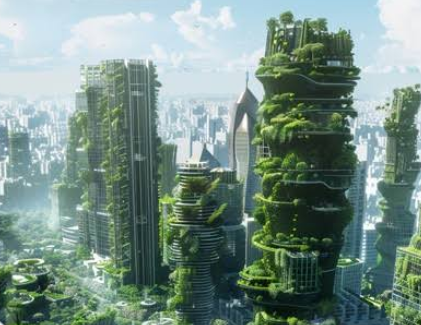
The current framework of United States land distribution treats the earth’s surface as an infinite financial asset rather than a finite ecological life-support system. To survive worsening ecological degradation, we must move past incremental conservation and look toward a total, systemic restructuring of land. I have developed a spatial and social engineering model that replaces financial boundary lines with strict, functional ecological zones. This model forces human development to look inward, prioritizing the reclamation of existing concrete and steel over the depletion of virgin resources.
The model divides the continental landmass into four distinct, functional zones:
Zone 0
Instantly locks all existing forests, wetlands, and critical ecosystems. Human habitation, resource extraction, and infrastructure development are strictly prohibited.
Zone 1
Dedicated entirely to non-harmful, regenerative ecological support systems.
Zone 2
Buffer zones between wilderness and urban centers. Individuals hold 12-acre stewardship rights. To preserve ecological continuity, any land reclaimed from larger historical estates is aggregated with adjacent clawed-back acres to create continuous, collectively managed wildlife corridors.
Zone 3
Repurposed commercial zones and high-density residential hubs.
Infrastructure & Efficiency
Rather than building new infrastructure, the model relies on the adaptive reuse of existing commercial places. To bypass the deep floor-plate limitations of skyscrapers, vertical atriums are core-drilled through the center of towers. The outer ring is converted to residential units, while the inner core hosts vertical hydroponic farms and localized micro-utilities. Strip malls and corporate office parks are converted into senior housing and multi-family structures. The expansive asphalt parking lots are instantly reclaimed for community parks, localized water filtration, etc. To eliminate resource-heavy commutes, commercial data lines are rerouted to residential sectors, transforming local retail hubs into tool-sharing and co-working centers.
Structural Logistics
To resolve the psychological friction of resetting property lines, the concept of permanent land deeds is replaced by 99-year(3 generation) Stewardship Leases. Land is not owned; it is temporarily inhabited. Lease footprints scale dynamically with family size up to a strict cap, returning surplus land to the collective pool without active state seizure when a household shrinks. Residential structures within Zone 2 must utilize a modular grid. Homes start as basic footprints, expanding via pre-fabricated, non-wood modules that snap into the structure as a family grows. When family members depart, these modules are uncoupled and returned to the regional resource stream. All new construction is restricted to rapidly renewable, carbon-sequestering materials, specifically hempcrete, rammed earth, and structural bamboo.
To build out the technical, ecological, and logistical framework of this model, here is an expanded breakdown of each zone’s operational mechanics, enforcement, and systemic integration.
Zone 0: Absolute Ecological Lock
Zone 0 is a hard boundary line established around all remaining virgin forests, wetlands, and critical watersheds. It operates on the principle of complete non-interference, recognizing that ecosystems require absolute isolation to heal and self-regulate. The primary objective is minimal human impact. No logging, mineral extraction, road construction, or permanent structures are permitted, with zero legal or economic exceptions. Human entry is restricted entirely. Ecological health is monitored remotely via satellite imagery, localized sensor grids, and non-invasive drone technology to track biodiversity index levels, canopy density, and water quality without physical disruption. These lands are removed permanently from any framework of valuation, state jurisdiction, or international trade agreements, acting as a sovereign global ecological trust.
Zone 1: The Zero-Kill Non-Agricultural Buffer
Zone 1 serves as a massive transitional buffer surrounding the wilderness of Zone 0. It is designed to regenerate depleted soils and support wildlife migration while entirely excluding traditional, destructive animal agriculture and intensive chemical farming. This zone acts as a biological sponge, absorbing edge-effect disruptions before they can impact Zone 0. It is heavily planted with native flora to encourage natural rewilding and maximize carbon sequestration. Traditional livestock grazing and monoculture farming are banned. Instead, any human utility within this zone is limited to low-impact, non-lethal activities such as wild-foraging of perennial plants, seed-banking, and the cultivation of native materials (like structural bamboo and hemp). Infrastructure is limited to unpaved, permeable pathways to allow wildlife to migrate across the landscape unimpeded.
Zone 2: The Stewardship Rings
Zone 2 is the primary zone for decentralized human habitation, acting as a low-density buffer between the dense urban cores of Zone 3 and the wilderness buffers of Zone 1. It completely restructures the relationship between residents and the land they occupy. Traditional private deeds are abolished and replaced with 99-year Stewardship Leases. Individuals or families are granted rights to a maximum footprint of 12 acres. Any acreage clawed back from historical, bloated private estates (such as reducing a 20-acre plot to the 12-acre standard) is not reassigned for human use. Instead, these reclaimed parcels are aggregated with adjacent clawed-back lands to form continuous, protected wildlife corridors winding through the human settlements. The local cluster of residents is collectively responsible for managing and protecting these corridors. To prevent land hoarding, leases scale with the household footprint. If a family grows, they may apply to upgrade their lease footprint within a larger local cluster; when the household shrinks, the lease footprint scales down, returning the excess land to the collective pool without active state seizure. To prevent the exploitation of this system, strict limits prevent households from increasing family size solely to acquire more land. Homes must be built on a modular grid using rapidly renewable, non-wood materials like hempcrete, rammed earth, and structural bamboo. A household starts with a minimal base structure. If needed, pre-fabricated modules are snapped into the existing structure. When those modules are no longer required, they are uncoupled and recycled back into the regional resource stream.
Zone 3: High-Density Urban Cores & Adaptive Infrastructure
Zone 3 concentrates high-density human habitation, culture, and heavy utility into existing urban footprints. It operates on a strict principle of zero outward expansion, forcing architectural and structural engineering to look inward and upward. To bypass the deep floor-plate limitations that typically make commercial skyscrapers unlivable, vertical atriums are core-drilled straight through the center of existing towers. This structural modification allows natural light and air to penetrate the building’s deep interior. The outer ring of the tower is converted into residential apartments, while the newly created inner core is utilized for vertical, indoor hydroponic gardens, localized micro-utilities, and waste-processing shafts. Strip malls and office parks are repurposed into multi-family housing and senior living facilities. Their massive asphalt parking lots are systematically torn up and converted into community parks, localized food forests, and decentralized water-filtration plants. To eliminate the resource drain of daily commutes, commercial data lines are rerouted into residential sectors. Former retail hubs, located within walking distance of residential clusters, are converted into localized co-working offices and tool-sharing libraries, ensuring residents can access high-tier infrastructure without relying on personal transportation.
This proposal represents a necessary departure from standardizing land by family or market value, offering instead a strict, resource-first blueprint for continental survival. No more million dollar homes with other people struggling to come up with rent. No more dumb rednecks that can’t read doing the destructive chores for them.